
The Science of Viral Hooks: What Makes People Stop Scrolling
You have less than 2 seconds. That's it. In the infinite scroll of social media feeds, two seconds is the window you have to convince someone your video is worth watching. Whether you're using an AI video editor or editing manually, understanding the psychology of hooks isn't optional anymore – it's essential.
The Psychology of Attention
Our brains are wired to filter information. With thousands of stimuli competing for attention at any moment, we've evolved to quickly assess what deserves our focus and what doesn't. In the context of scrolling through TikTok or Reels, this assessment happens almost instantaneously.
Research shows that several psychological triggers reliably capture attention:
Novelty
Our brains are hardwired to notice things that are new or unexpected. The unfamiliar triggers alertness – an evolutionary advantage that kept our ancestors alive.
Curiosity Gap
When we encounter incomplete information, our brains crave closure. This "information gap" creates psychological tension that can only be resolved by continuing to watch.
Emotional Resonance
Content that triggers strong emotions – humor, anger, fear, inspiration – bypasses our logical filters and demands attention. We feel before we think.
Self-Relevance
We're inherently interested in content that relates to us personally. Hooks that target specific audiences ("If you're a marketer..." or "For parents who...") capture attention through personal relevance.
Stakes & Conflict
Our brains are drawn to tension and conflict. Hooks that hint at high stakes or disagreement create anticipation about the resolution.
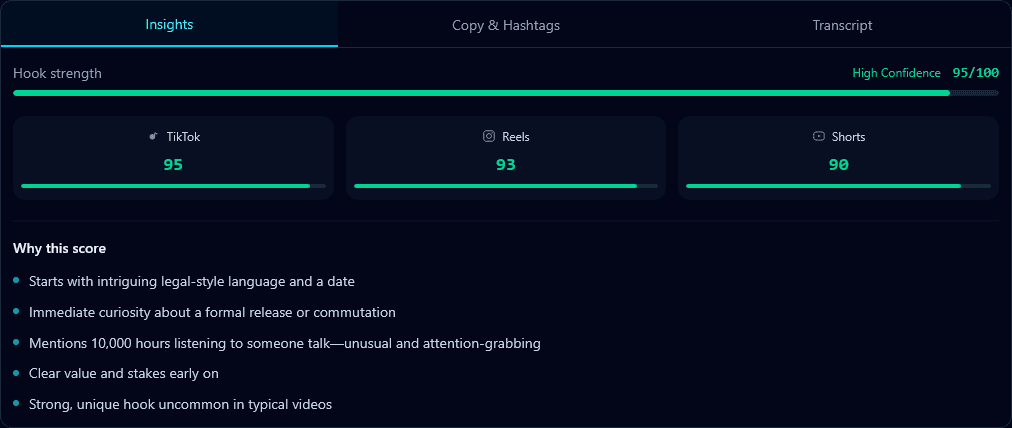
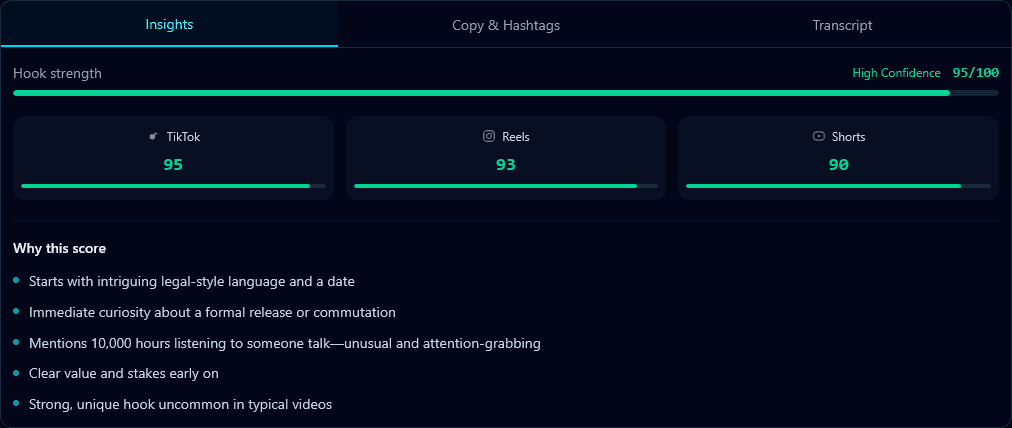
Klypse AI analyzes hook strength and explains why clips score high
Proven Hook Formulas That Work
While there's no guaranteed formula for virality, certain hook patterns consistently perform well. Here are the most effective:
The Contrarian Statement
"Everything you know about X is wrong..."
Challenges conventional wisdom. Works because it creates cognitive dissonance – viewers need to reconcile what they believe with this new claim.
The Direct Address
"If you're struggling with X, this is for you..."
Calls out the target audience directly. If viewers identify with the problem, they feel personally spoken to.
The Unexpected Outcome
"I tried X for 30 days and here's what happened..."
Promise of a story with results. Works because viewers want to see the transformation or outcome without doing the work themselves.
The Secret/Insider Knowledge
"The thing nobody tells you about X..."
Positions the creator as having exclusive information. Appeals to our desire to be in-the-know and not miss out.
The Specific Number
"3 reasons why X will change your life..."
Specificity signals confidence and organization. Numbers also help set expectations for the video's structure.
The Provocative Question
"Why are people still doing X when Y exists?"
Questions engage the brain differently than statements. They invite viewers into a mental dialogue.
The Mid-Action Start
[Video starts in the middle of an action or story]
In medias res – starting in the middle. Creates immediate intrigue because viewers need context. Works especially well for visual content.
Hook Mistakes That Kill Views
Starting with "Hey guys" or generic greetings
Social media isn't traditional video. You don't have established viewer loyalty yet. Every second of greeting is a second where viewers scroll away.
Explaining what you're going to talk about
"Today I'm going to show you..." is weak. Just show. Don't announce – deliver. Every word before the value is a potential exit point.
Slow pace in the first seconds
Long pauses, "umm"s, or low energy at the start signals that the rest of the video will be similar. Front-load your energy.
Burying the hook
Your most interesting point should be first, not last. Save the details for after you've earned attention.
Being too vague
"I'm going to show you something cool" isn't a hook. Specificity creates intrigue. "I'm going to show you the $5 gadget that replaced my $500 camera" is.
Visual Hooks: Beyond Words
Hooks aren't just verbal. Visual elements can stop the scroll before a single word is spoken:
- •Unusual visuals: Something that looks "off" or unexpected in the first frame triggers curiosity.
- •Text hooks on screen: Bold text overlay in the first frame can communicate the hook instantly, even without sound.
- •Pattern interrupts: Quick zooms, flash cuts, or visual disruptions that break the monotony of a feed.
- •Emotional expressions: A face showing strong emotion in the thumbnail naturally draws eyes.
- •Movement: Dynamic motion in the first frame signals energy and captures attention in a sea of static images.
Testing and Optimizing Hooks
The best creators don't guess – they test. Here's how to systematically improve your hooks:
Watch your retention curves
Most platforms show you where viewers drop off. If there's a massive drop in the first 3 seconds, your hook isn't working.
A/B test different hooks
Same content, different hooks. Post variations at similar times and compare performance. Let data guide your decisions.
Use AI scoring tools
Tools like Klypse analyze hooks and predict performance. AI can surface patterns across millions of videos that aren't obvious to humans.
Study what works in your niche
Analyze top-performing content in your space. What hooks are they using? Don't copy, but understand the patterns.
Master the Hook, Master the Platform
In the attention economy, hooks are currency. The best content in the world doesn't matter if no one sticks around to see it. Understanding the psychology behind what makes people stop scrolling is a fundamental skill for any modern creator.
The good news is that hooks can be learned and improved. Study the formulas. Analyze what works. Test relentlessly. Over time, creating compelling hooks becomes instinctive.
And remember: AI tools can now analyze hooks and predict performance before you post. When you turn videos into shorts, use every advantage available to give your content the best chance of being seen.
Let AI Analyze Your Hooks
Klypse scores every clip's hook strength and shows you exactly why some clips outperform others. Data-driven hook optimization.