
What's the Best AI for Clipping Podcasts?
"Best" depends on what you're clipping, and podcasts are the hardest case: multiple speakers, long runtimes, and quotes that have to be exact. Here's how to judge an AI podcast clipper on the things that actually decide clip quality.
Most AI clipping tools were built for a single talking head. Point them at a two-guest podcast and the cracks show immediately — a center crop that cuts a guest out, captions that misspell a name, a clip that starts mid-sentence. The best podcast tool is the one that handles the podcast-specific problems.
The three things that decide podcast clip quality
1. Multi-speaker framing
Two or three people on a 16:9 recording is the defining podcast challenge. You need real speaker tracking that follows whoever's talking, plus a clean split layout for rapid back-and-forth. This is the single feature that separates podcast-capable tools from the rest.
2. Caption accuracy
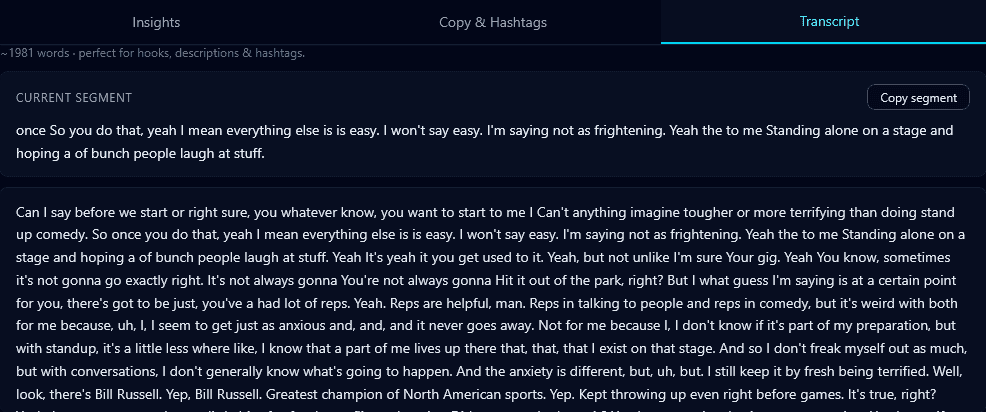
Podcasts are dense with guest names, brands, and niche terms. Captions built from a real word-level transcript — and editable before export — keep quotes correct. A misspelled guest name is the kind of detail that makes a show look amateur.
3. Cuts on natural speech
A clip that opens mid-word screams 'auto-generated.' Sentence-aware cutting that starts and ends on speech boundaries is what makes a clip feel edited by a human. Klypse never cuts mid-word.
What to ignore
Raw clip *count* is a vanity metric — 30 bad clips are worse than 8 good ones. So is speed if the output needs re-editing. Judge on the three things above, tested on your own episode.
How to choose in five minutes
- Upload one real episode (with two speakers) to the tool.
- Check: does the frame follow the active speaker, or cut someone off?
- Check: are guest names spelled correctly in the captions?
- Check: do clips start and end on complete sentences?
- If all three pass, it can handle your show. If any fail, keep looking.
Klypse was built around exactly these constraints — speaker-aware framing, transcript-accurate captions, and sentence-aware cuts — which is why it fits podcasters specifically. Compare options in the best podcast clippers roundup.
Frequently Asked Questions
What's the best AI for clipping podcasts?
The best podcast clipper handles multi-speaker framing, keeps captions accurate on names and jargon, and cuts on natural speech boundaries. Klypse is built around those three constraints. Test any tool on a real two-speaker episode before committing.
Why are podcasts harder to clip than other videos?
They have multiple speakers on a wide recording, long runtimes, and quotes that must be exact. Tools built for a single talking head cut guests out of frame and misspell names.
Does clip count matter when choosing a tool?
No — it's a vanity metric. Eight strong, correctly-framed, accurately-captioned clips beat thirty that need re-editing.
Turn your long videos into viral shorts
Klypse finds the best moments, tracks faces, and captions every clip automatically. Start free — no credit card required.
Related reading
More from the blog
How to Repurpose YouTube Videos Fast
Your back catalog of YouTube videos is a Shorts pipeline waiting to be tapped. Here's the fastest way to repurpose long-form YouTube content into short-form clips.
How to Make Viral Clips Automatically
"Viral" isn't luck — it's hooks, retention, and volume. Here's how to automate the parts of viral clip-making that are actually within your control.
How Does AI Find the Best Moments in a Video?
AI clip tools promise to surface your best moments — but how do they actually decide what's 'best'? A plain-English look at hook scoring and highlight detection.