
TikTok Algorithm Explained (2026)
How the TikTok algorithm actually works, what signals determine your reach, and exactly what you can do to get your content on the For You Page in 2026.
Why Understanding the Algorithm Matters
TikTok remains the most powerful organic discovery platform for creators in 2026. Unlike Instagram or YouTube, where existing audience size heavily influences reach, TikTok's recommendation engine evaluates every video on its own merits. A brand-new account with zero followers can accumulate millions of views if the content resonates with test audiences.
But that democratized reach comes with a catch: the algorithm is ruthlessly performance-driven. Videos that don't capture attention in the first moments get buried. Content that doesn't hold viewers to the end never escapes the initial test batch. Understanding what the algorithm measures — and optimizing your content accordingly — is the difference between 300 views and 300,000.
This guide breaks down the 7 ranking signals TikTok uses, the timing data behind hooks, practical watch time strategies, and how tools like Klypse help you turn videos into shorts that are engineered for algorithmic performance.
How the TikTok Algorithm Works
At its core, TikTok's algorithm is a recommendation system. It doesn't show videos based on who you follow — it predicts what each individual user will enjoy based on their behavior patterns, then serves content it believes will keep them on the platform longer.
The Distribution Cascade
- 1. Initial test batch (200-500 viewers) — When you post a video, TikTok shows it to a small group of users who have shown interest in similar content. This batch is chosen based on your content's topic signals: captions, audio, hashtags, and visual elements.
- 2. Behavior measurement — The algorithm tracks everything: how long viewers watch, whether they rewatch, if they share, comment, like, follow, or save. These signals are weighted and scored against benchmarks for similar content.
- 3. Expansion or suppression — If your video outperforms the benchmark for that test batch, TikTok pushes it to a larger audience (1,000-10,000 viewers). This process repeats through increasingly large batches. Each batch must outperform to unlock the next.
- 4. Plateau or viral breakout — Eventually the video either stops outperforming its batch (distribution plateaus) or continues climbing through millions of viewers. Most videos plateau within the first few batches.
The key insight: every video starts from essentially the same place. Your first 200 viewers determine everything. This is why content quality and hook timing matter far more than follower count or posting schedule.
The 7 Key Ranking Signals
TikTok has never published an official ranking of its signals, but through creator data, leaked documentation, and platform behavior analysis, these 7 signals consistently emerge as the most impactful — listed here in approximate order of importance.
1. Watch Time & Completion Rate
CriticalThe single most important signal. TikTok measures both absolute watch time (total seconds viewed) and completion rate (percentage of the video watched). A 15-second video watched to the end by 80% of viewers will dramatically outperform a 60-second video that most people abandon at the 10-second mark. The algorithm also tracks average watch percentage — if viewers consistently watch 95%+ of your video, TikTok interprets that as strong content-audience fit and accelerates distribution.
2. Shares
Very ImportantShares are the strongest active engagement signal. When a viewer sends your video to a friend or shares it to another platform, TikTok interprets this as "this content is valuable enough to recommend personally." Shares carry more algorithmic weight than likes because they require deliberate action and represent genuine endorsement. Videos with high share-to-view ratios consistently break through to larger audience batches faster.
3. Comments
ImportantComments signal deeper engagement than a passive like. TikTok weights comments by quality: longer, thoughtful comments and reply threads carry more weight than single-emoji reactions. Videos that generate debate, questions, or conversation threads signal high engagement value. The algorithm also considers comment velocity — a burst of comments shortly after posting is a strong positive signal during the initial test batch.
4. Likes
ModerateLikes are the most common form of engagement but carry the least weight per interaction. Because double-tapping is effortless, TikTok treats likes as a soft positive signal rather than a strong endorsement. That said, like-to-view ratio still matters — a video with an unusually high like rate relative to its view count signals broad appeal. Likes matter most when combined with other signals like high watch time.
5. Follows from Video
ModerateWhen a viewer follows you directly from a video, it tells TikTok that the content was compelling enough to make someone want more. This is a high-intent action that signals strong creator-audience fit. Videos that drive follows are more likely to be pushed to similar audience segments. Follow-from-video rate is especially impactful for newer accounts trying to establish a niche presence.
6. Rewatches & Loops
ImportantWhen viewers watch your video more than once, TikTok treats this as one of the strongest organic quality signals. Rewatches indicate the content was either so entertaining, informative, or visually compelling that the viewer chose to experience it again. Videos with high loop rates — especially short-form content that viewers watch 2-3 times before scrolling — regularly outperform videos with similar single-view completion rates. Designing content with a satisfying loop point (where the end flows naturally into the beginning) can significantly boost this metric.
7. Saves
ImportantSaves indicate long-term value. When a viewer bookmarks your video, TikTok interprets this as content worth revisiting — tutorials, recipes, tips, and reference material tend to get high save rates. The save signal has grown in importance through 2024 and into 2026 as TikTok prioritizes content with lasting utility over purely viral ephemeral clips. A high save-to-view ratio is especially powerful for educational and how-to content.
Hook Timing: The First 2 Seconds
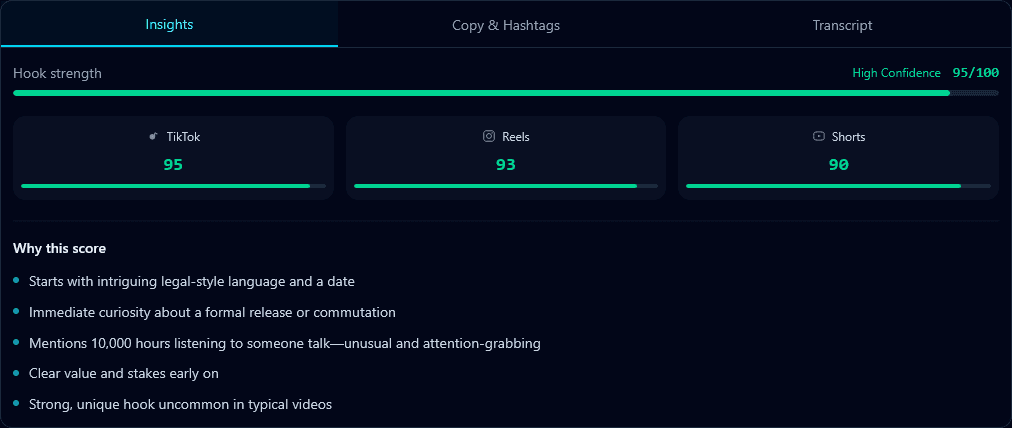
The opening moment of your video determines everything. TikTok's own creator resources confirm that most viewers decide whether to keep watching or scroll within the first 1-2 seconds. Internal data from creator analytics dashboards consistently shows that videos with strong opening hooks have 3-5x higher completion rates than videos with slow introductions.
Here's what the timing data reveals: videos that lose more than 30% of viewers in the first 2 seconds almost never escape the initial test batch. Conversely, videos that retain 70%+ of viewers past the 3-second mark have a dramatically higher chance of being pushed to larger audiences. The drop-off curve is steepest between seconds 1 and 3 — this is your make-or-break window.
What Makes an Effective Hook
- Visual disruption — Movement, bold text, unexpected imagery in the first frame. The thumbnail and opening frame must stop the scroll.
- Curiosity gap — Open with a statement or question that creates tension: "I tried this for 30 days and..." or "Nobody talks about this."
- Direct address — Speaking directly to the viewer ("You need to know this") creates immediate personal relevance.
- Pattern interrupt — Start mid-action, mid-sentence, or with an unexpected visual. Avoid intros, logos, or "hey guys" openings.
This is exactly why automated hook detection matters. When you turn videos into shorts using an AI video editor, tools like Klypse analyze your source footage to identify the strongest opening moments — the frames where energy peaks, key statements land, or visual interest spikes. Instead of manually scrubbing through hours of footage, AI clipping surfaces the moments most likely to hook viewers in that critical 2-second window.
Watch Time Optimization Strategies
Getting the hook right is only half the battle. You also need to hold attention through the entire video. Here are five proven tactics for maximizing watch time.
Pattern Interrupts
Every 3-5 seconds, introduce a visual or audio change: a camera angle shift, text overlay, zoom, sound effect, or scene cut. The human brain is wired to pay attention to novelty. When a video looks and sounds the same for more than a few seconds, viewers disengage. Pattern interrupts reset the attention clock and keep viewers watching.
Open Loops
Tease a payoff early but don't deliver it until the end. "Wait until you see what happened next" or "The third tip changed everything" creates psychological tension that keeps viewers watching to resolve the loop. Stack multiple open loops for longer videos — close one while opening another.
Visual Variety
Static talking-head footage with no visual changes is the fastest way to lose viewers. Add b-roll clips, screen recordings, text callouts, or split-screen elements. Even simple zooms and reframes make a significant difference — this is one reason why AI-powered reframing tools produce better-performing clips than raw exports.
Pacing and Energy
Cut dead air ruthlessly. Remove pauses, filler words, and slow transitions. The pacing of top-performing TikTok content is noticeably faster than traditional video. Every second should deliver value, entertainment, or tension. If a segment doesn't serve the viewer, cut it.
Caption Engagement
On-screen captions do more than accessibility — they create a secondary engagement channel. Viewers who are reading captions stay engaged longer because their eyes are actively tracking the screen. Animated word-by-word captions perform especially well, as each new word appearing creates a micro pattern interrupt that holds attention.
Content Formats That Perform in 2026
The algorithm doesn't favor specific formats, but certain structures consistently generate the engagement signals that drive distribution. These formats work because they naturally create hooks, hold attention, and encourage interaction.
Story Time
Personal narratives with escalating tension. Open with the most dramatic moment, then backtrack. High completion rates because viewers want to hear how it ends.
POV / Skit
Relatable scenarios that viewers see themselves in. These generate high shares ("this is so me") and comments. Keep them under 30 seconds for maximum loop potential.
Quick Tutorial
Step-by-step how-to content delivers immediate value. Tutorials drive saves (viewers bookmark for later) and shares (viewers send to friends who need the tip). The save signal alone makes this format algorithmically powerful.
Before / After
Transformations create natural curiosity: fitness progress, room makeovers, editing results. The anticipation of the "after" reveal holds viewers through the entire video.
Trending Audio
Using trending sounds signals to the algorithm that your content is culturally relevant. Videos with trending audio get an initial distribution boost because TikTok is actively promoting that sound to users who have engaged with it.
Case Studies: What Works
Fitness Creator: 3x Follower Growth in 2 Months
A fitness creator with 12,000 followers started posting 5 short clips per week extracted from their longer workout videos. By using AI clipping to identify the most energetic 30-60 second segments — moments with clear hooks like dramatic form corrections or personal records — they tripled their follower count to 38,000 within 8 weeks. Their average view count per video went from 2,000 to 45,000 because the shorter, hook-driven format naturally produced higher completion rates.
Podcast Repurposing: From Audio to 2M+ Views
A business podcast with a modest YouTube following began repurposing episodes into vertical clips with captions. The key was selecting moments with strong emotional reactions and controversial takes — not just any segment. One 45-second clip of a heated debate moment accumulated over 2 million views and drove 15,000 new podcast subscribers. The combination of face-focused vertical reframing, animated captions, and a strong opening hook made the clip native to TikTok despite originating from a long-form interview.
Educational Creator: Save Rate as a Growth Engine
A language teacher posting daily vocabulary tips found that their save-to-view ratio was 5x higher than their like-to-view ratio. By leaning into this — structuring each video as a clear, rewatchable reference — they built a library of content that the algorithm continued to distribute weeks after posting. Several videos saw second-wave distribution 10-14 days after initial posting, driven by the high save rates signaling lasting value.
Common Mistakes That Kill Reach
Slow Intros
Starting with "Hey guys, welcome back to my channel" or a logo animation is a death sentence. Viewers who don't know you have zero reason to sit through an intro. Cut straight to the value or the hook.
Wrong Aspect Ratio
Posting landscape or square videos with black bars is an immediate signal of low-effort content. TikTok is a vertical-first platform. Content that doesn't fill the screen gets lower engagement because it literally takes up less of the viewer's attention. Always reframe to 9:16.
No Captions
A significant portion of TikTok users watch without sound — estimates range from 30-50% depending on time of day. Videos without captions lose this entire audience segment, tanking completion rates. Captions also make your content accessible and add visual engagement.
Inconsistent Posting
Posting 10 videos one week and disappearing for three weeks trains the algorithm to deprioritize your content. Consistency keeps your account active in the recommendation pool. Set a sustainable cadence you can maintain long-term.
Ignoring Analytics
Not reviewing which videos perform and why means you're creating content blind. TikTok's analytics dashboard shows you exactly where viewers drop off, which traffic sources drive views, and which audience segments engage most. Use this data to iterate on what works.
How Klypse Helps You Win the Algorithm
Everything the algorithm rewards — strong hooks, high completion rates, vertical formatting, captions — is exactly what Klypse's AI video clipping tool is built to deliver.
Klypse analyzes your long-form videos and automatically identifies the highest-impact moments: the segments with the strongest hooks, the most engaging dialogue, and the best visual interest. It then reframes them to vertical 9:16 with intelligent face tracking (so speakers are never cropped out), adds animated captions for sound-off viewing, and exports clips that are ready to post.
Instead of manually scrubbing through hours of footage trying to find the 30 seconds that might perform, you get algorithm-optimized clips in minutes. More clips, better hooks, faster output — and every one formatted exactly how TikTok wants it.