
How to Make Viral Clips Automatically
Nobody can guarantee a clip goes viral. But virality isn't random — it's a stack of controllable inputs: a strong hook, tight retention, captions, and enough volume for the algorithm to find your winners. Here's how to automate those inputs with an AI shorts generator.
Stop thinking of 'viral' as an outcome you chase and start thinking of it as a probability you increase. Every controllable input you optimize raises the odds. Automation lets you optimize all of them, at volume, without burning out.
Input 1: The hook
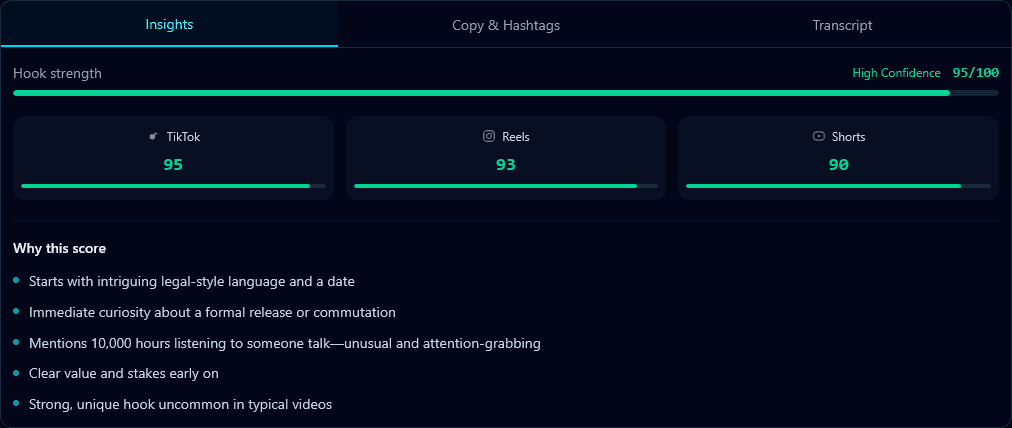
The first 1–3 seconds decide whether anyone watches the rest. The strongest hooks are usually buried mid-recording — the sharp line you said 12 minutes into a podcast. Klypse scores every moment for hook strength and surfaces the best openings first, so you clip *from* the hook. Read what makes a hook work.
Input 2: Retention
Watch time is the currency every short-form algorithm rewards. Sentence-aware cuts keep clips tight with no dead air, and clean framing keeps eyes on screen. A clip that holds attention gets pushed to more people — that's the whole mechanism.
Input 3: Captions
Most viewers watch on mute. Captions keep your message landing and measurably improve retention. Uncaptioned clips hand the algorithm a reason to stop showing them.
Input 4: Framing
A subject cut out of frame kills a clip instantly. Face tracking keeps the subject centered through movement, so the clip looks intentionally shot for vertical.
Input 5: Volume
Here's the uncomfortable truth: you can't predict *which* clip hits, so you need enough at-bats for the algorithm to find your winners. Automation is what makes volume sustainable — turning one video into 10+ optimized clips means more chances without more work.
Automate the hook selection, retention, captions, and framing, then post at volume — and virality shifts from luck to a numbers game you've stacked in your favor.
Frequently Asked Questions
Can AI make clips go viral?
AI can't guarantee virality, but it automates the controllable inputs that raise the odds: strong hook selection, tight retention, captions, and clean framing — at the volume needed for the algorithm to surface your winners.
What actually makes a clip go viral?
A strong hook in the first 1–3 seconds, high retention (watch time), captions for mute viewing, clean framing, and enough volume that the algorithm can find the clips that resonate.
Why does volume matter for going viral?
You can't reliably predict which clip will hit, so you need enough posts for the algorithm to find your winners. Automation makes that volume sustainable without extra production.
Turn your long videos into viral shorts
Klypse finds the best moments, tracks faces, and captions every clip automatically. Start free — no credit card required.
Related reading
More from the blog
How Does AI Find the Best Moments in a Video?
AI clip tools promise to surface your best moments — but how do they actually decide what's 'best'? A plain-English look at hook scoring and highlight detection.
Instagram Reels vs TikTok: Which Should You Post To?
Reels vs TikTok — the audiences, algorithms, and content styles differ more than they look. Here's how to decide where to focus, or how to win on both.
YouTube Shorts vs TikTok: Where Should Creators Focus?
YouTube Shorts and TikTok both offer huge short-form reach, but they reward different strategies. Here's how they compare on discovery, monetization, and audience.