
How to Start a Faceless YouTube Channel in 2026
You don't need to show your face to build a channel that earns — faceless channels now make up 38% of all new creator monetization ventures, up from 12% in 2022. But 2026 changed the rules: in mid-July, YouTube began stripping monetization from mass-produced AI content. The faceless channels that survive aren't the ones pumping out slop — they're the ones turning real, original long-form video into a stream of short clips. Here's how to be the second kind.
"Faceless" is one of the most-searched creator topics of 2026, and for good reason: it removes the single biggest barrier that stops people from starting — being on camera. No lighting, no on-screen confidence, no personal brand exposure. Just a topic, a voice or a script, and consistent output. The dream is real, and the earnings ceiling is genuinely high. But the floor collapsed this year, and most guides haven't caught up. This one starts with the reality.
The real numbers: what faceless channels actually earn
Let's separate the highlight reel from the median. The top of the market is enormous. Channels like The Infographics Show reportedly earn six figures a month; Daily Dose of Internet is estimated to pull between $138,000 and $388,000 monthly from ad revenue alone; Lofi Girl and Fern-style channels sit comfortably in the tens of thousands. A solo operator running a tight faceless channel can realistically reach $5,000 to $50,000 per month — without ever pointing a camera at themselves.
Now the floor. The median monetized channel earns about $4,800 per year — not per month — and roughly 97% never recoup their initial production investment. The average channel takes over 15 months to reach the monetization threshold. Faceless isn't a lottery ticket; it's a business with a long ramp. The people who win treat it like one: they pick a niche with real advertiser demand, they publish relentlessly, and they build a system so output doesn't depend on motivation.
The faceless channels that win in 2026 are not the ones making the most videos — they're the ones extracting the most distribution from each video they make.
The 2026 shift nobody warned you about: the AI-slop crackdown
This is the most important section in this guide, and it's the one most "start a faceless channel" articles skip. On July 15–16, 2026, YouTube rolled out an update to the Partner Program that renamed its old "repetitious content" rule to "inauthentic content" — and started enforcing it hard. Thousands of faceless AI channels had monetization suspended almost overnight.
Read the definition carefully, because it's the map to what's safe. YouTube defines inauthentic content as mass-produced or repetitive content — "content that looks like it was made with a template with little to no variation across videos, or content that is easily replicable at scale." The three categories in the crosshairs: repetitive AI-generated videos (verbatim text-to-speech over stock slideshows), emotionally manipulative clips, and synthetic AI personas covering sensitive topics like health and finance. Enforcement runs a three-strike system: warning, 90-day suspension, then permanent removal from the Partner Program.
Here's the part that matters: faceless is not banned. Low-effort is. YouTube explicitly clarified that a channel using AI tools inside a genuinely original production — with a real script, real editorial decisions, and original source material — remains fully eligible. The line isn't "did a human appear on camera." The line is "is there genuine original value here, or is this a template anyone could mass-produce?"
What this means for how you build
The safest, most durable faceless model in 2026 is no longer "generate 30 AI videos a week from a script prompt." It's the opposite: create one piece of genuinely original long-form content — a real analysis, a real interview, a real deep-dive — and repurpose it into many short clips. The long-form is your original value; the shorts are your distribution. Every clip traces back to real editorial work, which is exactly what the policy rewards. This is where the whole strategy below points.
Choosing a niche that pays (and survives the policy)
Niche selection decides two things at once: your RPM (what advertisers pay per thousand views) and whether your content reads as "original" or "template." Aim for niches that are high-CPM and inherently require a point of view.
The high-RPM tiers
- Finance & investing — $15–$40 per 1,000 views. Advertisers pay a premium; audiences are buyers. Requires genuine analysis, which keeps you policy-safe.
- Tech & AI tool breakdowns — the standout niche of 2026. New models and tools ship weekly, so the content pipeline is effectively infinite, and honest hands-on reviews are original by nature.
- Business & B2B, legal, real estate — routinely $10+ RPM. Narrow, professional, and hard to fake at scale.
- "Make money with AI" — the classic MMO niche with a 2026 twist: teaching real workflows, not recycled listicles.
The reach tiers (lower RPM, higher volume)
- Entertainment, compilations, curiosity — $2–$7 RPM, but enormous view potential and strong short-form virality.
- Health & wellness — lucrative, but now a sensitive category under the policy: an AI persona dispensing health advice is exactly what YouTube is targeting. Only enter with genuine expertise and original sourcing.
The 2026 winning move is micro-niching: not "AI" but "AI tools for real-estate agents"; not "finance" but "dividend investing for people in their 20s." General is saturated; specific is original by definition — and reads as authentic to both the algorithm and the policy reviewer.
Why short-form is the growth engine — and the hybrid advantage
You can build a faceless channel on long-form alone, but you'll grow far slower than you have to. The data on format mixing is overwhelming. According to YouTube's 2026 internal figures, creators posting both Shorts and long-form grow their subscriber base 3× faster than single-format channels, with total watch time up 2.5× in the first year. Channels posting Shorts daily for six months see 44% more overall growth.
The mechanism is simple: Shorts are the discovery layer and long-form is the retention-and-revenue layer. A short catches a stranger in their feed; your long-form (and your channel) is where the relationship and the higher RPM live. Faceless creators who understand this upload one long-form piece, then cut it into 5–15 vertical shorts that feed the discovery engine and point back to the source. You're not making two kinds of content — you're making one and distributing it two ways.
The workflow: one video into a week of content
Here's the operating system the sustainable faceless channels run. It's built to satisfy the "genuine original value" bar while producing enough volume to actually grow. This is the exact loop a long-video-to-shorts workflow is designed for.
Step 1 — Make one genuinely original long-form video
This is your policy-proof foundation and your highest-RPM asset. It can be a narrated analysis, a screen-recorded tutorial, a recorded conversation or interview, a documentary-style deep-dive — anything with a real script and real editorial decisions. You never appear on camera; your ideas do the work. Dense, spoken-word content is best, because it's the most clippable.
Step 2 — Let AI find the best moments
Upload it to an AI shorts generator. Instead of scrubbing an hour of footage, the tool transcribes the whole video and scores every candidate moment for hook strength, then hands you a ranked, best-first list of clip-worthy segments. A 30–60 minute source typically yields 10–20 distinct, self-contained moments — a week or more of short-form from a single afternoon of production.
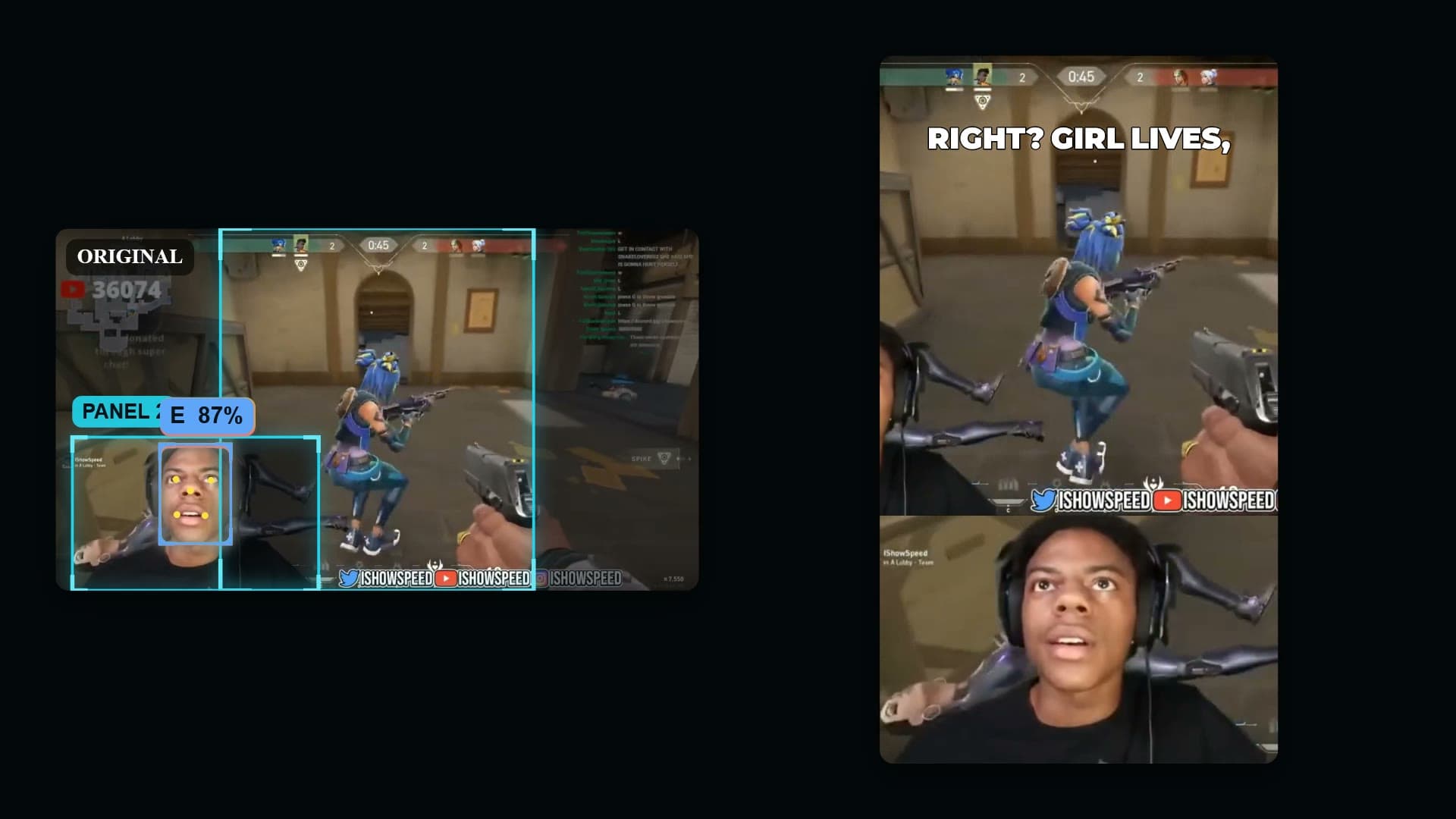
Step 3 — Reframe every clip to vertical, automatically
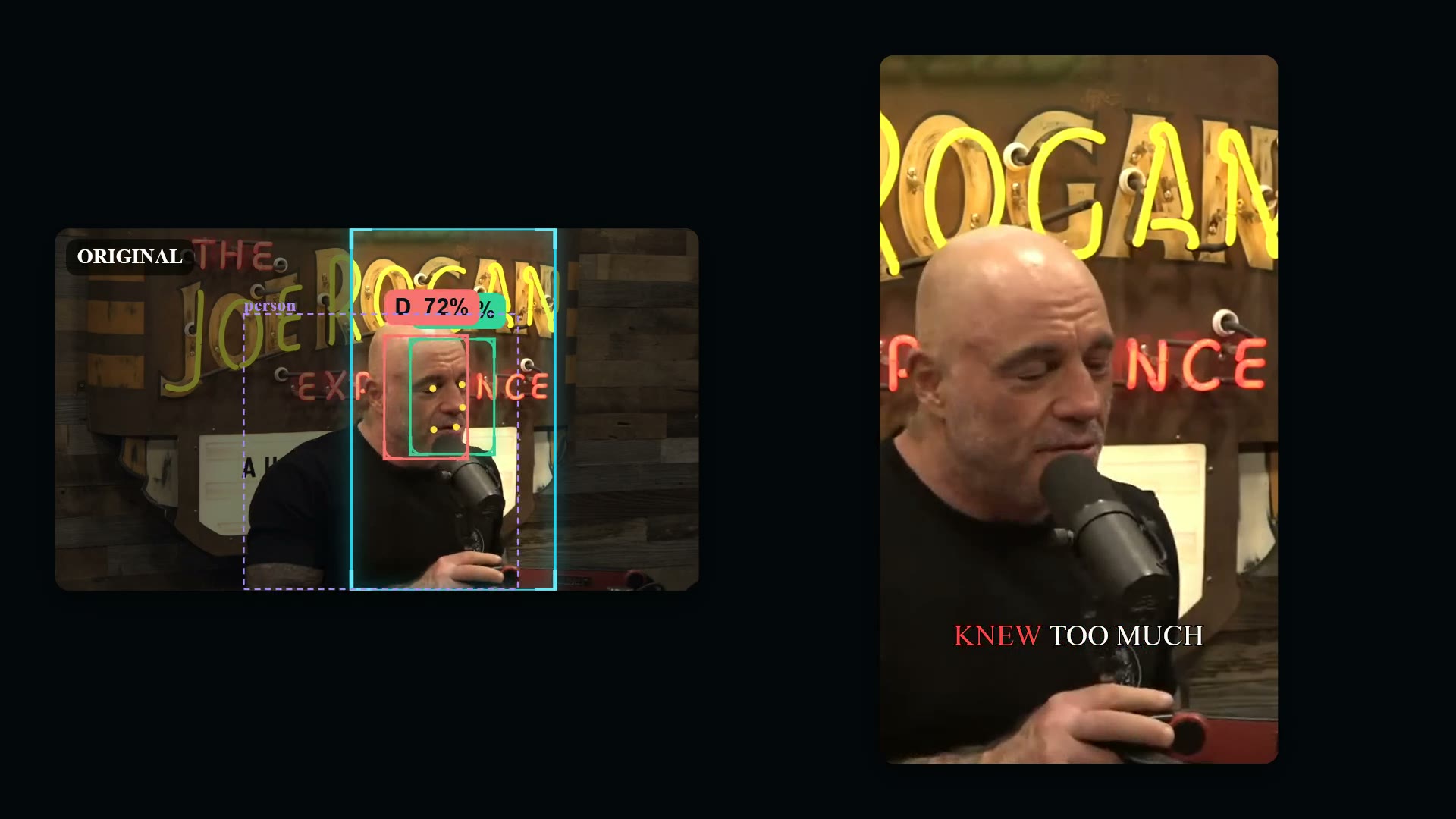
Shorts, Reels, and TikTok are 9:16; your source is probably 16:9. Doing that reframe by hand across 15 clips is a non-starter. Automatic landscape-to-vertical conversion crops each clip to vertical while tracking the active subject so nothing important — a speaker, a slide, an on-screen figure — gets cut out of frame. For multi-person recordings, speaker tracking follows whoever's talking.
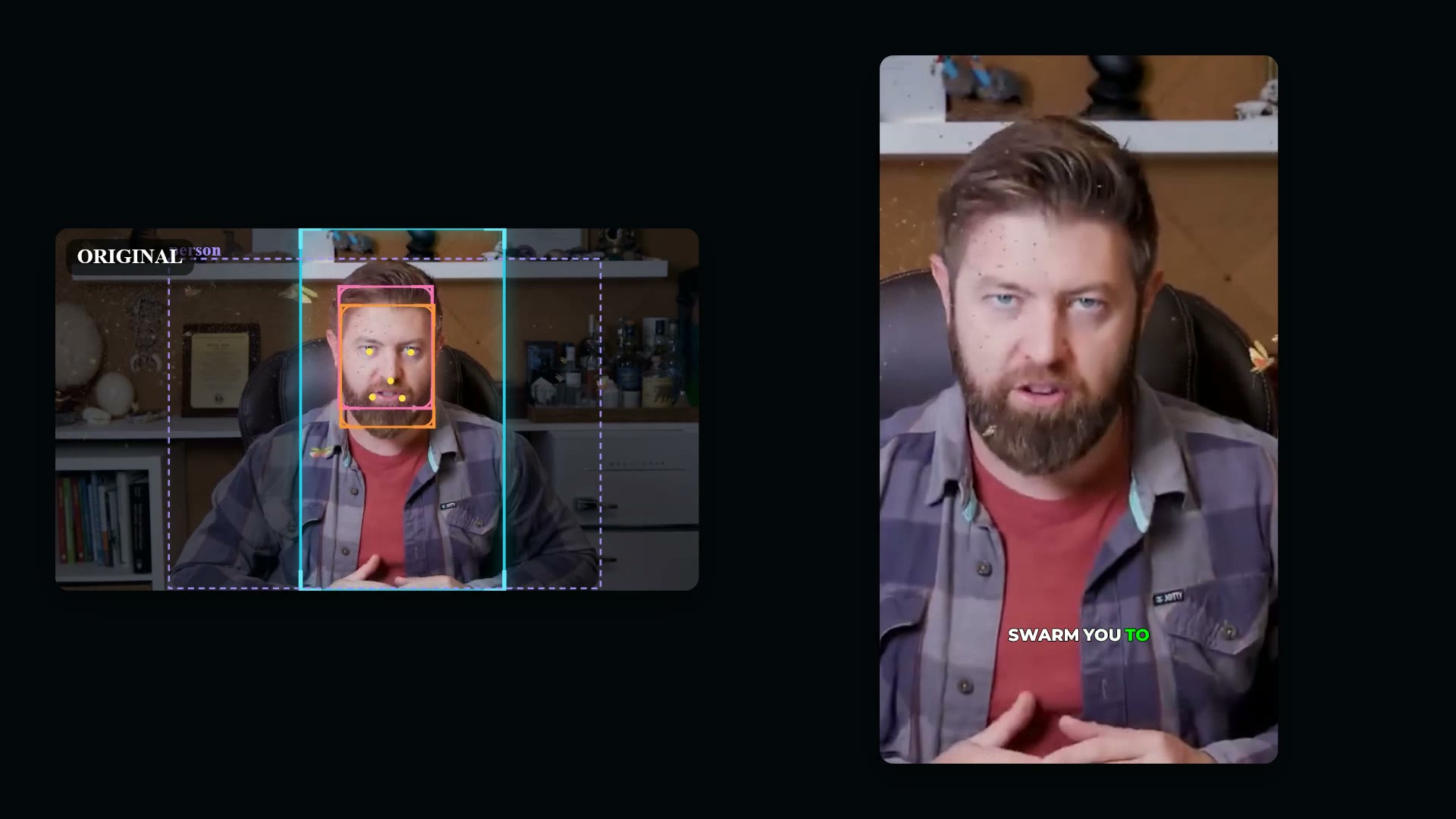
Step 4 — Caption everything (85% watch on mute)
Captions aren't optional for faceless content — with no face to hold attention, the words on screen are the retention mechanism, and most short-form is watched with the sound off. Every clip should get word-timed auto-captions placed in the safe zone so they never cover the action. This is also a quiet authenticity signal: properly edited, styled captions are the opposite of a template slideshow.
Step 5 — Sequence and post across platforms
Don't dump all 15 clips at once. Lead with your highest hook-scored clips — strong early performance teaches the algorithm to push the rest — and space them out over days. Cross-post the same clips to YouTube Shorts, TikTok, and Reels. Twenty captioned, reframed clips from one upload is a full month of daily posting.
Faceless done right vs. faceless that gets demonetized
It's worth making the contrast explicit, because it's the difference between a channel that compounds and one that gets a strike.
- Slop (at risk): a script prompt → robotic TTS → stock footage slideshow → published verbatim, 30× a week, no variation. Easily replicable at scale. This is precisely the template YouTube now demonetizes.
- Original faceless (safe + durable): a real long-form piece with genuine research and editorial choices → mined for its best moments → each clip reframed, captioned, and edited with intent → distributed across platforms. Every output is downstream of real work.
The tooling can be identical — AI transcription, AI clip detection, AI captions. The policy doesn't care that you used AI; it cares whether there's original value underneath. Repurposing your own real content is the cleanest way to guarantee there is.
Your first 30 days
- Pick one micro-niche with real advertiser demand and a point of view you can sustain.
- Produce two or three genuinely original long-form videos — your policy-proof, high-RPM base.
- Run each through a clip generator to pull 10–20 ranked short candidates per video.
- Reframe and caption every clip automatically; export ready-to-post.
- Post daily across Shorts, TikTok, and Reels, leading with your strongest hooks.
- Watch which clips over-perform, then make more long-form in those exact directions.
That loop — original long-form in, many distributed shorts out, feedback back into the next long-form — is the entire faceless business in one sentence. It scales, it compounds, and it sits on the right side of the 2026 rules. See the underlying method in the video repurposing guide, or just upload your first long-form video and watch it become a week of clips.
Frequently Asked Questions
Do faceless YouTube channels get demonetized in 2026?
Not for being faceless — YouTube confirmed faceless channels are not banned. What gets demonetized under the July 2026 "inauthentic content" policy is mass-produced, template-based, low-effort content (e.g. verbatim text-to-speech over stock slideshows). A faceless channel built on genuinely original content — a real script, real editorial decisions, original source material — remains fully eligible for monetization, even if it uses AI tools in production.
How much do faceless YouTube channels actually make?
The range is enormous. Top faceless channels earn six figures a month, and a well-run solo channel can realistically reach $5,000–$50,000/month. But the median monetized channel earns about $4,800 per year, and roughly 97% never recoup their initial investment. High-RPM niches (finance, tech, B2B) pay $15–$40 per 1,000 views; entertainment niches pay $2–$7. It's a real business with a long ramp — most channels take over 15 months to reach monetization.
What's the best faceless YouTube niche in 2026?
For earnings, high-RPM niches win: finance and investing ($15–$40 RPM), tech and AI-tool breakdowns (the standout 2026 niche, with a near-infinite content pipeline), and B2B, legal, or real estate ($10+ RPM). The key move is micro-niching — 'AI tools for real-estate agents' beats 'AI' — because specific content is original by definition and reads as authentic to both the algorithm and the monetization policy.
Do I need long-form videos, or can I just post Shorts?
You can start with Shorts, but the data strongly favors a hybrid approach: creators posting both Shorts and long-form grow subscribers 3× faster with 2.5× more watch time in year one. The most efficient faceless workflow is to make one original long-form video, then repurpose it into 10–20 shorts — the long-form is your high-RPM, policy-safe base, and the shorts are your discovery engine.
How do I turn one long video into many shorts without editing skills?
Upload the video to an AI clip generator like Klypse. It transcribes the video, scores every moment for hook strength, and surfaces a ranked list of the best clips — then reframes each to vertical with subject tracking and adds word-timed captions automatically. A 30–60 minute video typically becomes 10–20 ready-to-post clips in an afternoon, no manual editing required.
Turn one video into a month of faceless content
Upload a long-form video and Klypse finds the best moments, reframes them to vertical, and captions them — ready to post to Shorts, TikTok, and Reels. No face, no editing, no slop.
Related reading
Long Video to Shorts
The core faceless workflow — one upload, many clips.
AI Shorts Generator
Auto-find the best moments in any video.
YouTube to Shorts
Turn long YouTube videos into vertical clips.
One Video into 20 Shorts
The extraction method, step by step.
Video Repurposing Guide
The full repurposing framework.
More from the blog
How to Turn a Zoom Recording Into Short-Form Clips
A step-by-step guide to turning Zoom call recordings — webinars, interviews, and meetings — into vertical clips for TikTok, Reels, and Shorts.
How to Turn a Webinar Into Social Clips
Marketers spend weeks producing a webinar and then post it once. Here's how to repurpose a single webinar into a month of short-form clips.
How to Add Captions to a Podcast Video
Captions are what make podcast clips watchable on mute. Here's how to add accurate, well-placed captions to podcast video clips automatically.